
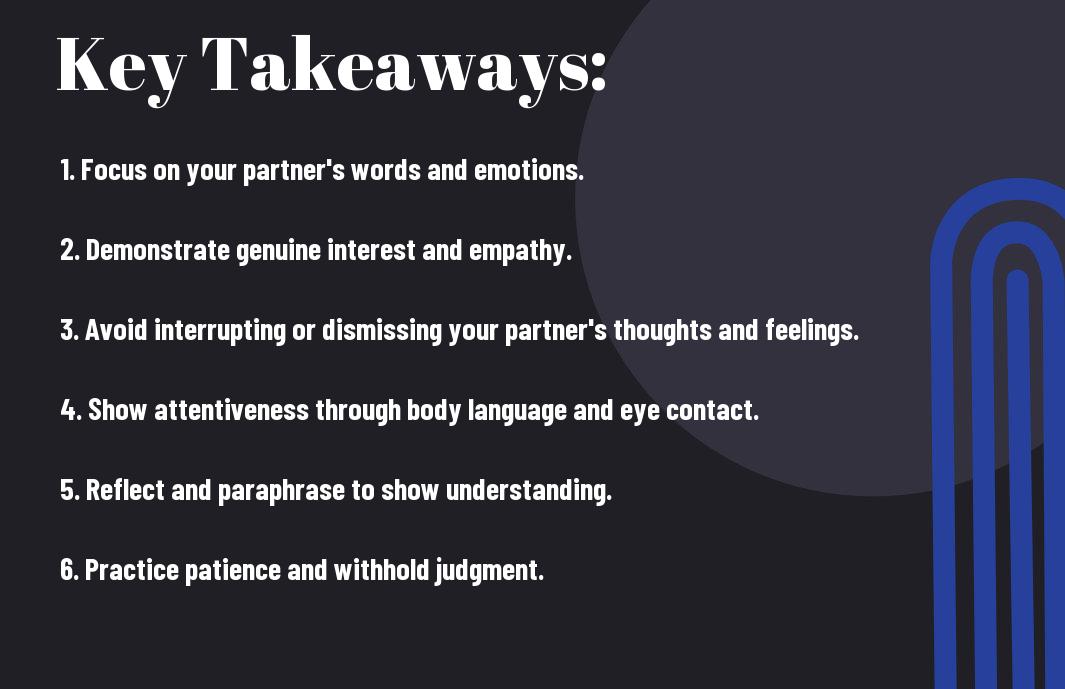
Key Takeaways:
- Focus on the speaker: Give your partner your full attention and avoid distractions.
- Show empathy: Demonstrate understanding and validation of your partner's emotions.
- Ask open-ended questions: Encourage your partner to share more and delve deeper into their feelings.
- Practice reflective listening: Repeat and paraphrase your partner's words to show that you are actively engaged in the conversation.
- Stay non-judgmental: Avoid jumping to conclusions or criticizing your partner's thoughts and feelings.
- Be patient: Give your partner the time and space to express themselves without interrupting.
- Validate your partner's emotions: Acknowledge and affirm your partner's feelings to create a sense of understanding and support.
The Mechanics of Active Listening
Assuming you are ready to fully engage with your partner, it is important to understand the mechanics of active listening. It's not just about hearing what your partner is saying, but truly understanding their words and emotions. This requires a conscious effort on your part to focus on your partner and actively participate in the conversation.
Eye Contact Tango: The Visual Whisper
When practicing active listening, maintaining eye contact with your partner is crucial. It shows that you are fully present and attentive to their words. The subtle act of meeting their gaze can communicate empathy, understanding, and support. However, be cautious not to stare intently, as this can come across as intimidating. Instead, think of it as a dance - a gentle back and forth of eye contact that conveys your interest and care.
Nodding Along: The Bobble-Headed Sign of Affirmation
As your partner speaks, nodding along is a simple yet powerful gesture that indicates you are actively listening and in agreement with their words. It shows that you are following along and acknowledging what they are saying. However, be mindful not to overdo it and appear insincere. A natural, occasional nod here and there can go a long way in affirming your engagement and understanding.

The Emotional Compass
Despite your best intentions, sometimes it can be challenging to fully engage with your partner's emotions. That's where the emotional compass comes in - it acts as a guide to help you tune into your partner's feelings and truly understand their perspective. By honing your active listening skills, you can navigate the complexities of emotions and strengthen your bond with your partner. If you want to learn more about how to start actively listening in your relationships, check out 5 Ways To Start Active Listening in Relationships.
Reading Between the Sighs: Deciphering Unspoken Words
When your partner lets out a sigh, it may seem like just a natural breath, but it can also reveal a lot about their emotional state. Pay attention to the context and the tone of the sigh - is it one of relief, frustration, or exhaustion? By actively listening to these unspoken cues, you can gain a better understanding of what your partner is feeling, even when they don't explicitly say it.
Emotion-ese: Becoming Fluent in Feeling
Emotions are like a language, and becoming fluent in "emotion-ese" can greatly enhance your ability to connect with your partner. Take the time to learn the nuances of their emotional vocabulary - the difference between feeling "overwhelmed" and "stressed", for example. By recognizing and validating their emotions, you can create a stronger emotional connection and demonstrate empathy and understanding.
The Feedback Loop
For a successful and fulfilling relationship, it's not enough to just hear your partner's words - you need to actively listen and engage with them. This involves more than just nodding along. It's about truly understanding and responding to what your partner is saying, both verbally and non-verbally. The feedback loop is an essential part of this process, allowing you to show your partner that you are truly present and engaged in the conversation.
Reflecting, Not Parroting: Echoes of Understanding
When practicing active listening, it's important to reflect back on what your partner has shared, rather than simply parroting their words. This means acknowledging their emotions, thoughts, and experiences, and showing that you understand and empathize with them. By reflecting on what your partner has shared, you demonstrate that you are truly engaged and attentive, which can deepen the bond between you.
Question Quests: Inquiries That Show You Care
Asking thoughtful and open-ended questions can demonstrate your genuine interest in your partner's experiences and emotions. When you ask questions that delve deeper into what your partner is sharing, you show that you care about their perspective and feelings, and you are eager to learn more about them. This can create a more intimate and meaningful connection in your relationship.
Active Listening in the Wild
After mastering the art of active listening in your personal relationships, it's time to take your skills out into the wild. Whether you're navigating workplace dynamics or orchestrating friendships with finesse, the principles of active listening will serve you well. For a comprehensive guide on how to use active listening to enhance your relationships, you can visit Using Active Listening to Enhance Your Relationships | USU.
Workplace Waves: Harmonizing Professional Conversations
In the workplace, effective communication is essential for success. By honing your active listening skills, you can navigate professional conversations with finesse. When you actively listen to your colleagues and superiors, you not only show respect for their ideas and perspectives, but you also gain valuable insights that can help you contribute more effectively to the team. By truly understanding the needs and concerns of your coworkers, you can build trust, strengthen collaborative efforts, and avoid misunderstandings that could potentially derail a project. Your ability to tune into the unspoken emotions and concerns of your colleagues will set you apart as a perceptive and valuable team member.
Social Symphony: Orchestrating Friendships with Finesse
In your social circles, active listening can help you navigate friendships with finesse. Whether you're catching up with old friends or making new connections, really tuning into what others are saying shows that you value their thoughts and feelings. By doing so, you create deeper, more meaningful connections and strengthen your social bonds. Actively listening in social situations also allows you to pick up on subtle cues that can help you support your friends through tough times or celebrate their successes more meaningfully. By being fully engaged in your conversations, you validate and support those around you, creating a positive and lasting impression.
Conclusion: Engage in Active Listening for Stronger Connections
Presently, you have learned the importance of fully engaging with your partner's words and emotions through active listening. By actively listening, you are able to strengthen your connection with your partner and build a deeper understanding of their thoughts and feelings. Remember to stay present, show empathy, and maintain eye contact to truly connect with your partner and foster a strong, healthy relationship. So, put down the distractions, tune in, and watch your relationships thrive as you become a master of active listening!
FAQ
Q: What is active listening?
A: Active listening is more than just hearing what your partner is saying - it's about fully engaging with their words and emotions, showing that you are genuinely interested in what they have to say.
Q: Why is active listening important in a relationship?
A: By practicing active listening, you can strengthen your bond with your partner, improve communication, and show them that their thoughts and feelings are valued.
Q: How can I show that I am actively listening to my partner?
A: You can show that you are actively listening by maintaining eye contact, nodding, and using verbal and nonverbal cues to demonstrate that you are engaged in the conversation.
Q: What are some common barriers to active listening?
A: Common barriers to active listening include distractions, interrupting, and formulating a response while the other person is still speaking. It's important to be mindful of these barriers and actively work to overcome them.
Q: How can I improve my active listening skills?
A: You can improve your active listening skills by practicing empathy, asking open-ended questions, and giving your full attention to your partner when they are speaking.
Q: What are the benefits of practicing active listening in a relationship?
A: The benefits of practicing active listening in a relationship include deeper connection, increased trust, and a better understanding of your partner's needs and emotions.
Q: What if I struggle with active listening?
A: If you struggle with active listening, it's important to be patient with yourself and continue practicing. Consider seeking help from a therapist or counselor to further develop your active listening skills.